By Herb Weitzman, Executive Chairman, Weitzman
January 12, 2026 I Post originally ran in D CEO Magazine
Texas benefits from the power of four major metros that each have their own economic drivers, cultures, attractions and topographies. But Weitzman’s new Texas retail market report shows that these four distinct metro areas all have one thing in common: stellar population, housing and job growth powering record or near-record retail occupancy for their retail markets.
D-FW SETS A RECORD - AGAIN
For the third year in a row, the Dallas-Fort Worth retail market has achieved record overall occupancy.
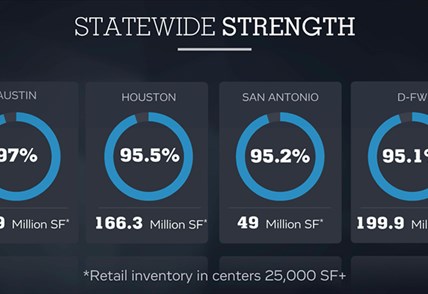
As of year-end 2025, the retail market posted record occupancy of 95.3 percent, following the previous records set in 2024 and 2023 when the market achieved 95.1 percent occupancy.
At year-end 2025, D-FW’s inventory totaled 202 million square feet in retail projects with 25,000 square feet or more.
New deliveries are dominated by anchor stores, with extremely limited development of new small-shop space. That factor is driving a lot of retail demand from fitness, apparel, discounter and entertainment/experiential users to existing properties, further increasing the market’s occupancy.
For calendar year 2025, space delivered in new and expanded retail projects totaled approximately 2.4 million square feet, a notable jump over 2024’s deliveries of 1.5 million square feet.
Even with the increase, deliveries overall remain extremely conservative for a market reporting record-high occupancy and a healthy level of retail demand as retail concepts look for new locations in what is arguably the country’s strongest metro economy.
Most tellingly, more than 82 percent of the new space in 2025 is dominated by grocery store anchors as traditional, specialty and superstore grocers expand to meet the demands of D-FW’s growing population.
AUSTIN REMAINS TEXAS’ TIGHTEST RETAIL MARKET
Austin’s retail market at year-end 2025 maintained its near-full-occupancy of 97 percent due to steady leasing demand, well-leased new construction and limited large-format store closures.
Austin is once again the healthiest major retail market in Texas in terms of occupancy and balanced supply and demand. The retail market’s health reflects the strength of the overall Austin-area economy, which ranks as one of the strongest in the country.
The Austin retail market’s occupancy percentage is based on an inventory of approximately 53.9 million square feet in retail projects with 25,000 square feet or more.
Active construction in 2025 totaled approximately 1.1 million square feet, compared to 486,000 square feet in 2024.
The jump in new construction is due to the anchors that opened during the past year, including Lowe’s, H-E-B, Home Depot and a number of junior boxes for fitness, discounter and entertainment concepts.
The new deliveries in 2025 also mark the first time construction has exceeded the 1-milllion-square-foot point since 2016.
HOUSTON MAINTAINS MARKET HEALTH
Houston’s retail market in 2025 reported strong retail space demand that resulted in healthy marketwide occupancy of 95.2 percent at year-end.
The occupancy rate is based on Weitzman’s review of Houston’s retail market inventory of approximately 167.5 million square feet of space in multi-tenant retail projects with 25,000 square feet or more.
Expanding small-shop tenants remained active in 2025, with the most notable demand coming from restaurants, high-tech boutique fitness, services, beauty, medical and dental uses. Junior anchors such as discounters, specialty grocery stores, entertainment and fitness concepts are especially active, creating significant demand for the well-located box vacancies on the market.
Even long-vacant boxes, like a former Gander Mountain that went dark in 2017, found new tenancy in 2025.
During calendar-year 2025, the greater Houston retail market delivered approximately 1.1 million square feet in new and expanded retail projects consisting of 25,000 square feet or more.
During 2024, deliveries totaled more than 1.3 million square feet.
Overall, deliveries remain on the conservative side, especially for a tight retail market with nearly 170 million square feet of inventory serving one of the country’s most robust major metropolitan areas.
SAN ANTONIO PROJECTS RETAIL STRENGTH
San Antonio’s retail market as of year-end 2025 maintained near-record-high occupancy thanks to demand-based new construction, steady leasing in existing retail and few new retail closings, especially from large-format concepts.
As of year-end, the market reported overall occupancy of 95.3 percent due to stable tenant retention and strong demand for well-located vacancies.
For example, multiple leading concepts expanded this past year in backfilled space.
The market is also reporting an increase in new construction, but the deliveries overall increase occupancy because they are primarily for anchor stores and largely pre-leased shop space.
The occupancy rate is based on Weitzman’s review of a total San Antonio retail inventory of approximately 49.6 million square feet of retail space in multi-tenant shopping centers with 25,000 square feet or more.
For the calendar-year 2025, the market added approximately 561,000 square feet in new and expanded retail projects with 25,000 square feet or more.
The 2025 total represents an increase over 2024’s deliveries of approximately 423,000 square feet. Most notably, new anchor spaces from concepts like DICK’s House of Sport, H-E-B, Academy Sports and Top Golf accounted for nearly 66 percent of all new space in 2025.
The deliveries also mark San Antonio’s most active new-space market since 2019, when approximately 868,400 square feet were added to the market.
San Antonio’s retail market currently reports a healthy balance of supply and demand, and the outlook for 2026 expects that health to continue.
San Antonio ranks as one of the nation’s fastest-growing large cities and enjoys low unemployment and a robust annualized job growth.
With a strong combination of job growth and population growth, the outlook for San Antonio’s retail market remains positive for the foreseeable future.
Weitzman’s optimism about the retail market performance in 2026 is based in part on San Antonio’s economic performance.